Scan · Walk · Discover
Kaapsche Hoop Heritage Trail
A self-guided walk through the old village, built from archival research. Every stop is on this one page — load it once and the whole trail stays on your phone.
There is no signal on most of the trail
Tap once here, while you still have bars, and every stop and photograph loads now. Keep this tab open and the whole walk works with no signal.
The trail map
Tap any number to jump straight to that stop. GPS works even with no signal.
Commissioner’s House
The administrative heart of the district
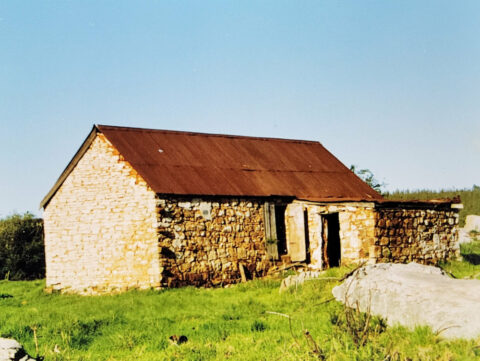
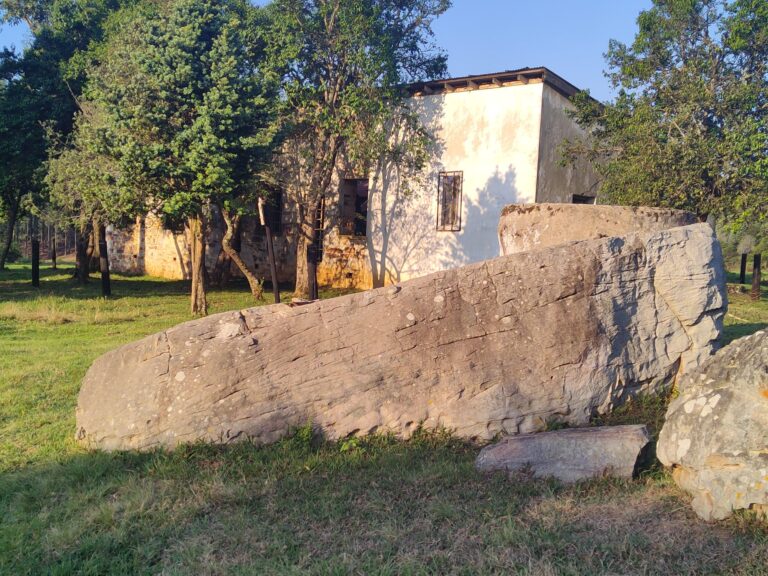
You are standing within what was once known as Kommissaris Plein (Commissioner Square) — the administrative heart of the district, and the ground the Republic chose when it decided to govern this mountain.
This stone building is known in the village as the Commissioner’s House, and it is one of the older surviving structures on the square.
The Commissioner
In August 1882 the South African Republic sent a Gold Commissioner to a mountain where almost nothing existed. He was to register claims, issue licences, settle disputes and represent the State on a frontier several days’ ride from the nearest magistrate.
He was given a title and very little else.
Within weeks he was writing to Pretoria that he was working under canvas, that he had advertised for tenders for an office and nobody had answered, and that there was no gaol here at all. A safe was sent up to him and arrived without a key. He went the better part of a year without salary while holding several hundred pounds of public money he had no instructions how to send anywhere. Paper ran out, and a year later he was still writing official letters on a printed form because none had come. In the middle of an argument with Pretoria about a building, he wrote that his head wanted to burst.
This is the part of the story the usual histories leave out, and it is the one the archives support.
Recorded as Police Quarters
An official Public Works site plan dated 19 September 1927 identifies this building as “Police Quarters.”
By then the precinct on this square had grown to include court functions, police administration, holding facilities and accommodation for police, who stayed until 1974.
A building across generations
- 1927 — recorded on a government plan as Police Quarters
- Mid-20th century — in continued police use
- 1974 — the police leave the square
- Today — a surviving building on the historic government square
What is documented, and what is not
The 1927 plan is firm evidence — it names this building. The nineteenth-century history of this particular structure is not yet established from documents, and this trail does not claim it. The archives record government buildings on this square from the 1880s, and rather more of them than the two or three usually described. Connecting any one record to any one surviving building is work still in progress.
Heritage significance
The Commissioner’s House stands on the square where formal government came to this mountain — where claims were registered, disputes settled, licences issued, and the authority of the State established on a frontier.
Its own story is still being recovered from the archives. That is not a weakness of the building; it is the ordinary condition of a small frontier settlement whose paperwork went to Pretoria and whose memory stayed on the mountain.
The Post Offices of Kaapsche Hoop
The mail came before the village did
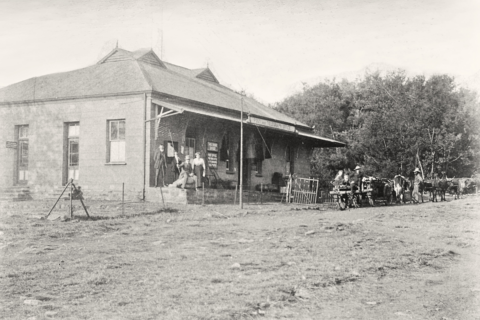
The Republic sent a Gold Commissioner here in 1882, to a mountain with no town on it. The fields were not proclaimed until 1885 and the stands were not surveyed until 1887 — but by April 1883 the Government was already paying a contractor to carry the mail to his office.
For its first year that office had no fixed home. Later the post office was a room on a plan, in a building shared with the court. Only in 1898 did this village get a building put up to be a post office, built by a contractor named H. Wilke. That building is Stop 05, and it is no longer standing.
What is documented, and what is not
The mail contract of 1883, the room marked “P. Office” on the 1884 plan, and the 1898 building with its contractor named are all in the government files. Where the post office sat between those dates is not settled, and this trail does not pretend otherwise.
Printer & Publisher of The North Kaap Telegraph
The man who printed Kaapsche Hoop’s newspaper, 1888
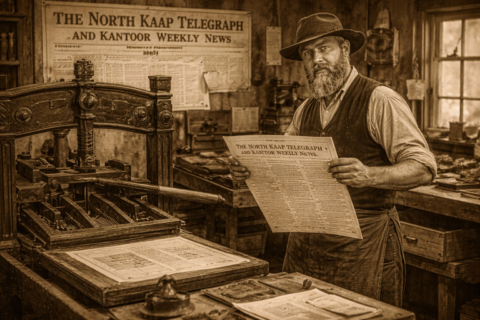
AI re-created illustration.
This village had its own newspaper, and it was printed here. The North Kaap Telegraph and Kantoor Weekly News sold for sixpence, came out on Wednesdays, and carried under its masthead the words “Authorised Medium for the Insertion of all Government Notices relating to the North Kaap.”
The imprint
“Edited and Published by the Proprietor, Bryce Boyd, Duivel’s Kantoor, Kaapsche Hoop, South African Republic.”
A quarter’s subscription cost 6s. 3d., half a year 12s. 6d., a year £1 5s. — payable in advance. He sold the paper through agents from the International Hotel here to Barberton, Johannesburg and Natal, and he took in job printing.
Six months, one volume
The archive holds seven issues, all from 1888 — July, September, October and November. Every one of them is still Volume One.
The issue numbers date it. Volume I, No. 6 is 25 July 1888; No. 20 is 31 October; No. 24 is 28 November. Counting back a week an issue puts the first Telegraph at about 20 June 1888 — and the village’s own record holds that the paper lasted about six months. It never reached a second volume.
What Boyd printed is the reason the rest of this trail can name the village’s butchers, blacksmiths, hotel keepers and shopkeepers at all.
What is documented, and what is not
The title, price, day of publication, imprint, subscription rates and agents are all read from the surviving papers, and the numbering is their own. The exact first and last issues have not yet been found, and tracing them is part of ongoing archive research.
Government Building
One roof over the office, the court and the cell
You are standing in the government precinct. In July 1884 a digger named P. A. Ogilvie drew a plan, to scale, of the Government Offices here — sixty-five feet of coursed stone, thirty feet deep, a flagpole at the front, and eight rooms inside.
It is the finest single document the village holds about how the Republic meant to govern this mountain.
Eight rooms, one roof
A long, low, single-storey range facing west onto the square. Inside, in one line:
- The Gold Commissioner’s office
- A post office
- A courtroom — the largest room in the building
- A dining room and two bedrooms
- A kitchen, standing detached behind
The State, the mail, the court and the Commissioner’s own bed, all under a single roof. That was ordinary on a frontier, and it tells you how thin the administration was.
One cell, one constable, one wall
At the north end, walled off from everything else, are two more rooms: a prison, and a room for the constable. No door connects them to the offices. Each is entered from outside, through its own doorway in the end gable, and the constable’s room sits between the cell and the square.
You could not reach the lock-up from the Commissioner’s office. You had to walk out of the building and round to the end of it.
Built for £230 — so the Commissioner said
D. M. Wilson, the Commissioner who worked here, wrote that President Kruger approved £230, that a farmer nearby supplied the stone and lime, and that an Irish constable named Pat Murphy put the building up using the labour of men held in the cell.
Wilson wrote that in 1901, seventeen years later, and confirming it remains part of ongoing archive research. It is a good story. It is not yet a document.
The year it emptied
At the end of 1890 this village had a Landdrost holding court and a Mining Commissioner registering claims. Within about a year both offices were gone, replaced by a clerk and a justice of the peace.
In February 1891 the Republic’s own paperwork records this building as now unused — and hands it to the Telegraph Department.
It did not lose its occupants to a better building. It lost its establishment.
What is documented, and what is not
The plan is firm — signed, dated, drawn to scale. The construction story is Wilson’s memoir. The 1891 closure and the long record of complaint are in the government files. What the paperwork does not settle is how much of what Ogilvie drew was actually built as drawn. A plan is an intention, not a wall.
Afterwards
A telegraphist worked here and was still asking for repairs in 1893. In 1899 someone was still buying the building a flagpole, thirty-five feet long, fifteen years after Ogilvie drew one. By 1905 a resident complained there was no magistrate and no court here at all. A government plan of 1927 names this ground Court House, Gaol and Married Quarters.
The court sat until 1967. The police stayed until 1974. Nearly ninety years — but not ninety unbroken ones. The interruptions are the interesting part, and the guided walk covers them with the documents in hand.
The New Post Office
The only one built to be a post office
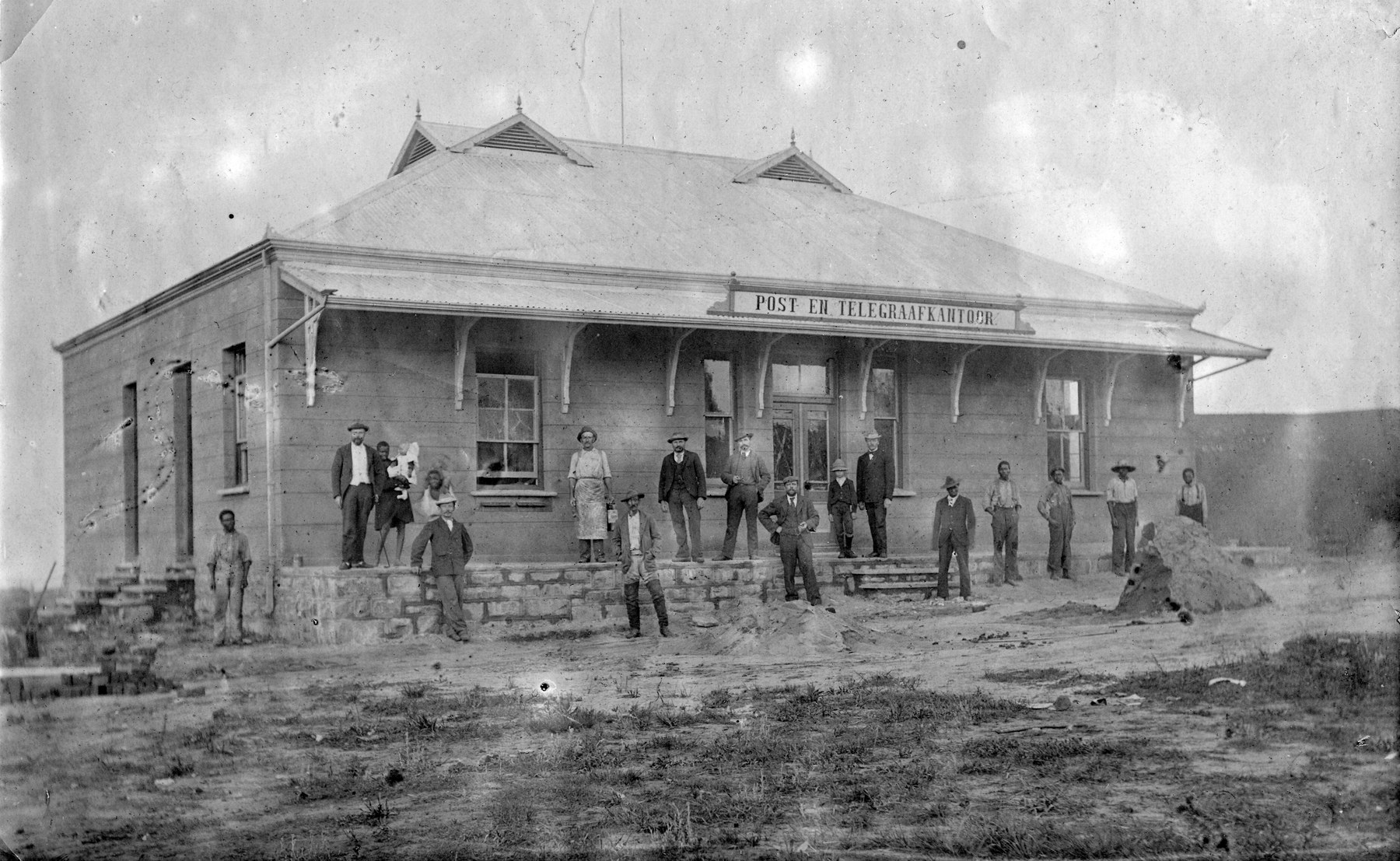
The Post en Telegraafkantoor at Kaapsche Hoop, photographed when it was new — sand heaps and cut stone still lying on the ground. From a family album.
This is the site of the Post and Telegraph Office of 1898 — the last of the village’s postal arrangements, and the only one put up for the purpose.
The Republic had specified a whole government block for Kaapsche Hoop in 1889 and never built it. The project was revived in December 1897, cut down to a post and telegraph office with a dwelling for the director. The contractor was H. Wilke. A local commission reported on his work weekly through the winter of 1898, and the building was finished that December.
It is not the building in front of you. The 1898 post office was sold at a government auction in 1991 and altered. Some years afterwards it burnt down, and what stands here now was built again on the same ground.
What is documented, and what is not
The specification of December 1897, the weekly building reports and the completion in December 1898 are all in the government files, with the contractor named. The sale of 1991 is documented in the project archive. The fire and the rebuilding are held in local record, and this trail makes no claim about how much of 1898 lies underneath.
← Read the Post Offices of Kaapsche Hoop
Pilgrim’s Rest Hotel
Kaapsche Hoop (Duivel’s Kantoor)
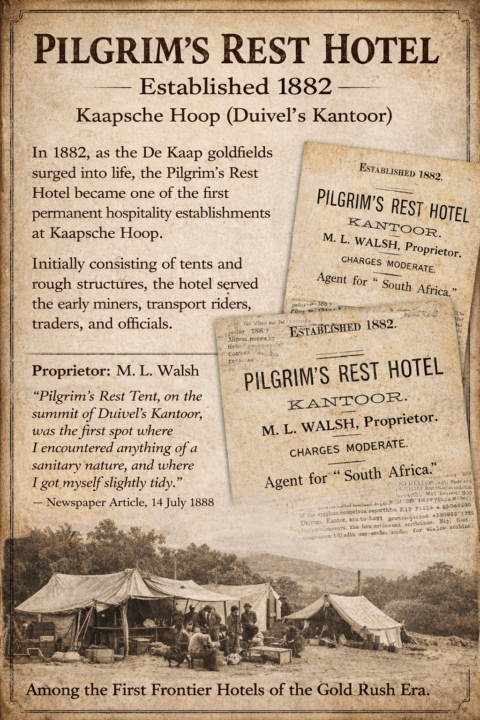
AI re-created illustration.
The hotel advertised in the village’s own newspaper right through 1888, and the wording never changed:
“ESTABLISHED 1882. PILGRIM’S REST HOTEL, KANTOOR. M. L. WALSH, Proprietor. CHARGES MODERATE. Agent for ‘South Africa.’”
The proprietor is buried in this village
Matthew Leonard Walsh. His death notice gives his birthplace as Dublin, Ireland, his trade as hotelhouder — hotel keeper — and his death at Kaapsche Hoop on 19 March 1895, aged forty-two. It names five children. The second was born here in December 1888, the same season his advertisement was running three columns from the Government notices.
Before it was a hotel
A traveller’s account published in July 1888 describes arriving at what the writer calls “Pilgrim’s Rest Tent, on the summit of Duivel’s Kantoor…” — a reminder of what an hotel on this mountain had been not long before. The paper reports a dance held here in September of the same year.
What is documented, and what is not
The advertisements, the traveller’s account and the death notice are all held in the archive, and this trail follows them.
The International Hotel
Comfort, civility and cleanliness on the escarpment
“TRAVELLERS to and from Barberton will find Comfort, Civility, and Cleanliness at the above Hotel. A Reading Room on the Establishment, where all the latest Newspapers are filed, and a well stocked Library kept. GOOD STABLING. BATH ROOM. BILLIARD ROOM.”
That is the International Hotel and General Store, Duivel’s Kantoor, advertising in 1888. The proprietors were Van der Byl & Barter.
Read it again
A reading room, a filed run of the latest newspapers, and a stocked library — on this mountain, in a village of tents and iron, at the end of a bad road from Barberton. A bath room and a billiard room with them.
The man behind the counter
W. H. Barter did more than keep an hotel. He sold the North Kaap Telegraph from these premises as its Kantoor agent, and in November 1888 a public meeting held in this building elected him one of the stewards for the village’s Old and New Year sports. The Landdrost took the chair.
What became of it
By the 1920s this block belonged to Edward Henry Frederick Topham, a Kaapsche Hoop storekeeper, who took it out of a liquidation in November 1922. Under him the International took the name the Kaapsehoop Hotel.
That building was condemned, and nothing of it remains. In March 1939 Topham sold the whole block — twelve stands for £400 — to George Lutz, who built a new Kaapsehoop Hotel on different ground. That one is Stop 13. This is not it, and this is not its site.
The trade never left this block
On 15 June 1922 the Barberton Liquor Licensing Court sat to consider an application from Edward Topham for a bottle liquor licence on Stands 35 and 39 to 41, Kaapsche Hoop. This ground — named, numbered, and printed in a government notice.
The International stood here. So did the Pilgrim’s Rest and the Caledonian. Topham’s hotel was condemned; the buildings are gone. The pub on this block today is the Nagkantoor — the night office, against the Devil’s own.
Drink has been sold on this block since 1888, and it is being sold on it now.
What is documented, and what is not
The advertisement, the newspaper agency and the public meeting are all in the 1888 papers; the liquor licence application is Notice No. 314 of 1922; Topham’s ownership and the 1939 sale to Lutz are in the Deeds Office register. The change of name and the condemnation are held in local record.
Parsons’ New Store
Kaapsche Hoop (Duivel’s Kantoor)
“PARSONS’ NEW STORE HAS BEEN OPENED AT THE KANTOOR. Varied Stock of Drapery Goods, Clothing, &c., &c. PRODUCE AT LOWEST PRICES. J. PARSONS, OPPOSITE THE INTERNATIONAL HOTEL.”
A shop opening, in three lines
The newspaper trailed it in July 1888: “Mr. Parsons’ new store at the Kantoor will be opened shortly.” In September it reported that he had “received some additional loads of goods during last week.” By November the advertisement above was running.
Three lines, four months apart — and between them you can watch a shop being opened. Announced, stocked, then advertising for trade.
He was not the only one
Fowlie & Moore advertised at Kaapsche Hoop as direct importers and dealers, wholesale and retail. R. Schurink kept a general store here and at Waterfall. Morrison & Co. opened a store and canteen the same year. In a village this size, in 1888, that is four shops competing.
What is documented, and what is not
The advertisement and both news paragraphs are in the village’s own newspaper, and this trail follows them. What Parsons sold beyond drapery and clothing, and how long he lasted, are part of ongoing archive research.
Trading Store
Part of the working back-of-house — see Stop 11
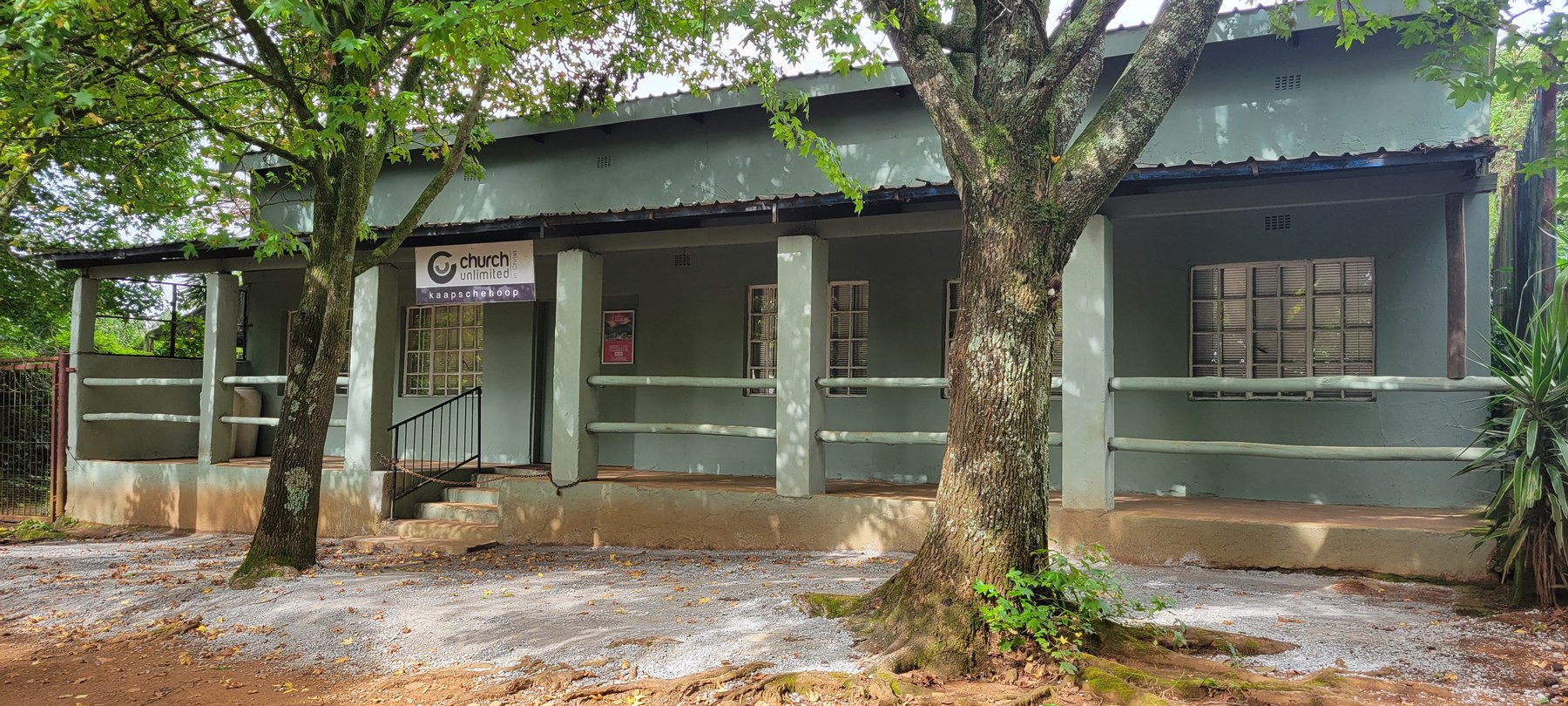
The trading store building, still standing — today it houses Church Unlimited.
This pin sits within the service and trading zone behind the hotels. The full story of the blacksmith, farrier, stables and shoemakers who worked here is told at Stop 11.
The Butchers of Kaapsche Hoop
Provisioning the diggings
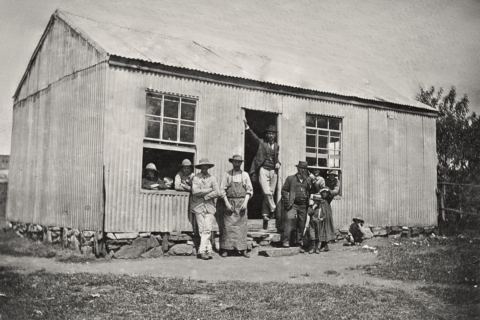
Two butchers served this village in 1888 — and both of them told the newspaper they were the older.
“HOLTZHAUSEN BROS. & CO., BUTCHERS, KANTOOR AND WATERFALL. The Oldest Established Butchery at the Kantoor. DAILY SUPPLIES OF MEAT. OXEN, HIDES, AND SHEEPSKINS BOUGHT AND SOLD.”
“THE KANTOOR BUTCHERY AND BAKERY. W. HAWKINS. First-class Beef and fresh supplies of Bread daily. Mealie Meal and Forage kept. ESTABLISHED 1882.”
They ran in the same paper, in the same weeks. Hawkins sold bread as well as beef, and kept meal and forage for the horses that brought people up the mountain.
The third butcher
He is documented not by an advertisement but by his death. William Lambourn — son of the prospector Charles Rupert Lambourn and Fanny Frances Perrin of Kaapsche Hoop, and brother of the Daisy Lambourn who married Johannes Marthinus Nel. His death notice gives his occupation in one word: butcher.
He died on 14 February 1901, aged twenty-five, in the Race Course Hospital at Pretoria, where the burial register records him as a Boer prisoner of war. He was born in the Transvaal and registered British. He is not buried here.
What is documented, and what is not
Both advertisements, the death notice and the Pretoria burial register are held in the archive. Which butchery was in fact the older is a question the advertisements raise and cannot answer.
Trades & Service Yards of Kaapsche Hoop
Blacksmith · Farrier · Shoemaker · Service yards
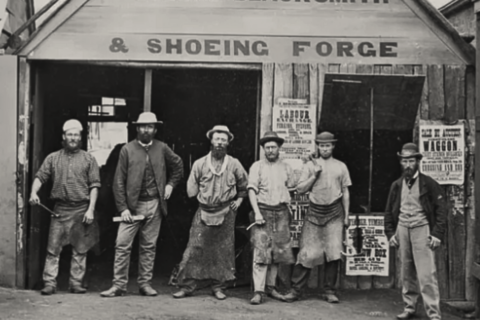
The working trades of this village are named in two records, forty years apart.
From its own newspaper, 1888
H. Juby, blacksmith and wagonmaker · Kitter & Duffield, wagonmakers, blacksmiths and farriers · W. Hawkins, butcher and baker · R. Schurink, general dealer at Kaapsche Hoop and Waterfall · Fowlie & Moore, direct importers · J. Parsons, draper and clothier.
From the voters’ rolls, 1925 to 1931
Daniel du Plessis Oosthuizen, shoemaker — skoenmaker — listed here in 1925, 1927 and 1931 · William McGillivray, carpenter, across the same three rolls · John Mitchell, blacksmith · Willem Adriaan Nel and Andries Coetzee, builders · Albert Edward Hawkins, painter · Arthur Alexander Christensen, well-digger · Christopher Cary, motor mechanic · Robert Hull, transport rider, on all three rolls.
What is documented, and what is not
The 1888 names come from advertisements in the North Kaap Telegraph; the later ones from the Polling District 11 voters’ rolls. The rolls name only those entitled to vote, and a third of that register is written down simply as “labourer”. This is the village’s trade as the record chose to write it down — not all of it.
The Blacksmith of Kaapsche Hoop
The sound of the frontier
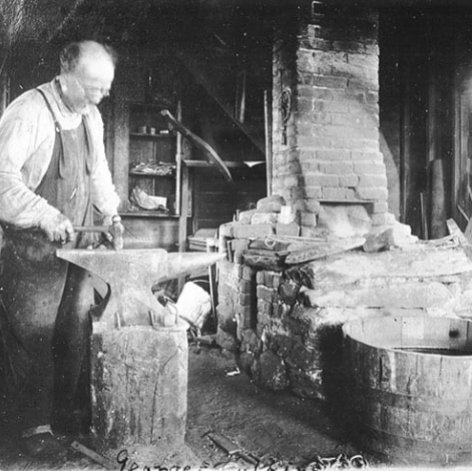
This village had two forges, and they advertised against each other in the same newspaper.
“BLACKSMITH AND WAGONMAKER, KANTOOR. H. JUBY. All Classes of Wagonmaking and Farrier Work executed with promptitude.”
“KITTER & DUFFIELD, WAGONMAKERS, BLACKSMITHS & FARRIERS, KANTOOR. A Good Stock of Seasoned Timber always on hand. WORK DONE ON SHORTEST NOTICE.”
Both ran in the North Kaap Telegraph in 1888. Juby’s is the most often repeated Kantoor advertisement in the whole archive — he bought the same space week after week.
And one of those names is in the village cemetery
Christopher Duffield, wagon maker — born 18 October 1830, died 23 March 1887 — is buried in the Kaapsehoop Historical Cemetery, and his grave is there to be visited. The firm of Kitter & Duffield was still advertising here sixteen months after his death.
A surviving partner keeping the name, a son carrying it on, or another man of the same surname. The archive does not yet know which.
And there is iron in the ground
Blacksmith’s ironwork has been found on Stand 143, on du Preez Street, at this stop. The deeds register that stand only as bare ground — a deeds office records land, never trades — so the iron is the evidence, not the paper.
Whether it belongs to the rush of the 1880s or to the working village of the 1900s is not yet settled. Hand-wrought and machine-made ironwork differ, and a closer look at what has been found should date it.
What is documented, and what is not
The two advertisements and the cemetery record are held here, and this trail follows them. Christopher Duffield’s trade, his dates and his grave in this village are all documented, and the ironwork on Stand 143 is physically here. Whether he is the Duffield of the firm, and which period the iron belongs to, are part of ongoing archive research.
The Kaapsehoop Hotel
A mid-century village anchor
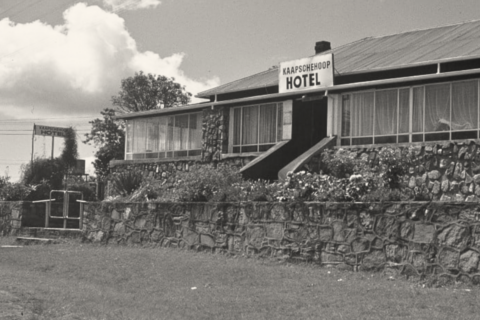
By the mid-twentieth century, Kaapsehoop was no longer the boom town it had been in the 1880s — but it was still very much alive. The Kaapsehoop Hotel, built and operated by George Lutz, became one of the clearest signs of that continued life on the mountain — and it was a new building on new ground. The hotel it replaced, the old International at Stop 07, had been condemned.
The Deeds Office register dates it closely: Lutz took this Kruger Street ground in August 1938, out of the estate of the storekeeper John Parsons, and seven months later bought the old hotel block from Edward Topham. By 1951 the deed record reflects the name “Kaapsehoop Hotel” — marking the period when the hotel was formally established and trading under that identity.
For decades, the hotel served as Kaapsehoop’s social and practical hub — a place where visitors arrived by road, locals crossed paths, and the village maintained a sense of community during a quieter, rural chapter of its history.
A Mid-Century Village Anchor
Unlike the rough timber-and-tent hospitality of the rush years, the Kaapsehoop Hotel represents a different chapter:
- Kaapsehoop as a settled village, not a mining camp
- Local trade and small-town routines
- A steady flow of visitors in the decades before modern tourism fully arrived
The hotel remained open and operational until the late 1980s, making it one of the longest-running hospitality landmarks in the village’s history.
The Petrol Pump & “Stop-over” Culture
One detail remembered by many is the old petrol pump positioned to the left side of the hotel frontage — a reminder that Kaapsehoop had become a road destination. People didn’t only come to sleep over — they came to refuel, rest, and reconnect.
More Than a Hotel
George Lutz was not only a hotel proprietor. He also operated a convenience store in the village, reinforcing how closely hospitality and local trade were linked in Kaapsehoop’s later economy.
Together, the hotel and store helped keep the village functional through decades when many old mining towns disappeared entirely.
Nel Cottage
The domestic heart of life on the escarpment
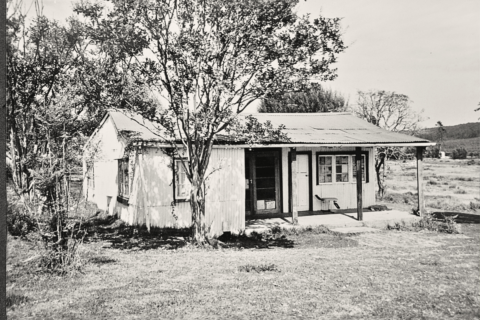
You are standing at the corner of the Nel family’s ground. Erven 164, 167 and 168 — one block on President Square and Kantoor Street — came to Willem Adriaan Nel by Crown Grant: 168 in February 1915, 164 that April, 167 in October 1924. The 1925 voters’ roll lists him as a builder.
In May 1932 he passed all three to his son Johannes Marthinus Nel, a miner. The block stayed in the family until May 1949, when his estate transferred it to Elsie Catharina Susanna Elizabeth Davis — thirty-four years of one family on one corner.
Three generations of Nels grew up in this house, and the village holds it to be the oldest cottage in Kaapsehoop.
Unlike the government buildings across the square, this was a home — a place where a family was raised while the village emptied around it.
What is documented, and what is not
The three Crown Grants and the transfers of 1932 and 1949 are in the Deeds Office register, and this trail follows them. The register records land, not buildings. No house at Kaapsche Hoop has yet had its fabric dated — the cottage’s age rests on family record and village knowledge, and dating it is part of ongoing archive research.
Today: The Uitspan Museum & Coffee House
Saved from deterioration, Nel Cottage now operates as the Uitspan Museum & Coffee House. The building remains active and welcoming, preserving its domestic scale and historical character. Visitors can explore rooms reflective of early mountain life while enjoying simple hospitality.
On weekends and public holidays, the Uitspan offers sweet and savoury pancakes, good coffee, and a relaxed village atmosphere.
From the sunny porch, Dana Snyman operates a small bookstore featuring selected works and mounted photographic displays. Adjacent to the main house, the historic carriage house has been rebuilt on its original footprint and now serves as an intimate venue for private gatherings of up to 25 guests.
Lambourn Homestead
Prospectors, herbalists and storytellers of the De Kaap
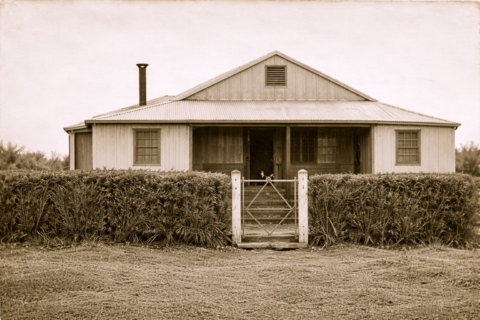
AI re-created illustration.
You are standing near the historic Lambourn Homestead — home to one of Kaapsehoop’s earliest and most enduring frontier families.
The Lambourns arrived during the great rush migrations that transformed the Eastern Transvaal in the late nineteenth century. Their story follows the movement of the diggings themselves, tracing the earliest wave of diggers who pushed steadily eastward across the escarpment in search of fortune.
A Family of the Rush Frontier
Charles Rupert Lambourn was among the pioneering prospectors who worked across the major Transvaal diggings. Historical accounts place him within the first wave of diggers moving from Lydenburg, to the booming Pilgrim’s Rest goldfields in the Lydenburg district, and onward toward Duivelskantoor, before settlement took root at De Kaap (Kaapsehoop).
Prospecting demanded mobility, resilience, and risk. Camps shifted constantly, fortunes rose and vanished overnight, and families often followed uncertain opportunity into remote landscapes.
The Lambourns were part of the generation that turned temporary diggings into permanent communities.
A Household on the Mountain
The homestead supported a remarkable family of twelve children, raised in conditions far removed from established towns. Daily life combined survival and enterprise: mining and trade, livestock and food preparation, practical craftsmanship, and deep knowledge of the surrounding environment.
Large frontier families formed the social backbone of early Kaapsehoop, sustaining settlement long after the initial rush began to fade.
Butchers, Botanists & Herbal Knowledge
The Lambourn family became widely known for skills extending beyond mining. They worked as butchers, supplying meat to miners and residents, while also developing a reputation as keen observers of the mountain’s natural world.
Family tradition recalls an exceptional understanding of local plant life. Using wild mountain flowers and indigenous herbs, the Lambourns produced a healing salve used to treat working and transport horses — animals essential to mining and transport on the escarpment.
The exact preparation was closely guarded within the family, passed only through trusted knowledge. Sadly, the formula was never formally recorded. If preserved, it may have represented one of Kaapsehoop’s earliest examples of frontier veterinary herbal practice — knowledge now lost to time.
Storytellers of Early Kaapsehoop
Like many pioneer families, the Lambourn legacy survives through memory as much as documentation. Stories told within this homestead spoke of long prospecting journeys, life between camps, hardship and humour on the mountain, and the transformation of De Kaap from mining rush to village community.
Through storytelling, history moved from one generation to the next.
From Prospectors to Settlers
As production declined, families such as the Lambourns remained. Their transition reflects Kaapsehoop’s broader history: from transient diggings, to settled mountain village, to heritage landscape.
The homestead stands as evidence of permanence achieved after years of uncertainty.
Legacy on the Mountain
Members of the Lambourn family remain deeply connected to Kaapsehoop’s historical landscape, with several generations linked to the village cemetery and founding-era community networks.
Ongoing archival research continues to reconnect documents, family records, and physical sites across the mountain.
The Kaapsche Hoop Emporium
Landsberg & Kruger Streets
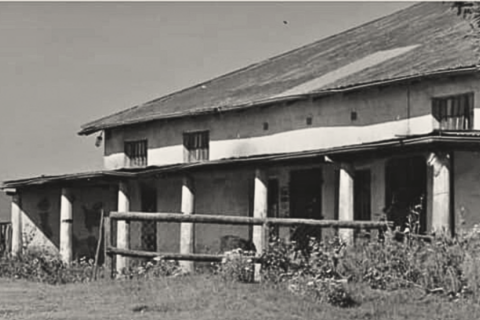
By the 1920s, Kaapsehoop had long passed its peak — but it remained a functioning mountain village. At the intersection of Landsberg Street and Kruger Street, a large commercial property occupied Stands 82 to 86.
This was the Kaapsche Hoop Emporium.
Recorded in the Deeds — 1927
The deed register records that in 1927 the property was held by Milly Kaplan, born Hoffman, trading as Kaapsche Hoop Emporium.
The use of the term Emporium suggests a general dealer and supply store — providing groceries, dry goods, household items, and essential provisions for residents. The footprint across five stands indicates a well-established trading presence in the village.
Purchase by George Lutz — 1938
In 1938, the property was transferred to George Lutz, born 7 November 1897.
Lutz would later establish the Kaapsehoop Hotel around 1951, linking the Emporium and the Hotel in the village’s mid-20th-century commercial life. After acquiring the property, Lutz operated a convenience store here — continuing its function as a central supply point in town.
A Later Chapter
The Emporium represents the survival of Kaapsehoop beyond mining, the transition from boomtown to rural village, and the economic continuity that kept the mountain inhabited.
Where early hotels served prospectors, the Emporium served families.
The Government School
Education, permanence and community on the mountain
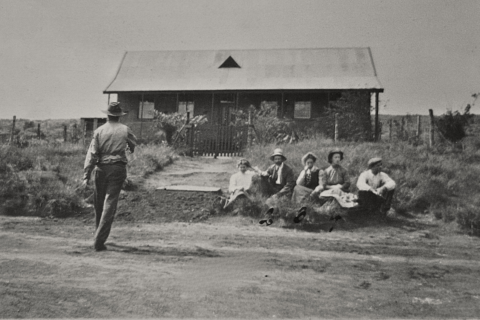
You are standing on the site of the Government School. Nothing of it stands.
A 1999 newspaper account of the village records that the building was demolished in the 1960s. The ground — Stand 233, reserved for educational purposes on 12 April 1909 — carries a private house today.
Where the schooling began
The school opened on 7 January 1895 under a teacher named D. Wiarda. His school stood at Uitkyk, with a Kaapsche Hoop postal address — near the village rather than in it, which is how education usually began on a frontier.
The earliest named pupils come from just before that. In December 1894 two children were entered on declarations of indigence, as free pupils.
The village gives its school away
By 1897 the community could no longer carry it, and the school commission formally offered its school to the Government for takeover under Wet No. 15 of 1896. The correspondence grinds on for more than a year. That is how it became a State School: not by founding, but by surrender.
The schoolmaster who redesigned his own school
Philippus Johannes Kloppers arrived at the beginning of 1898. He was twenty-three, born at Arnhem in the Netherlands.
In September 1898 he telegraphed Pretoria about what the new school building should be. He wanted iron, on a stone foundation, and gave his reason plainly: the climate here is so damp that in summer one cannot lay brickwork.
Then he read the plan — and proposed changes to it. Public Works amended the design. In May 1899 he learned that the Volksraad had approved the building and recorded that he had heard it with joy. Two instalment certificates were paid through 1899.
Then the war stopped it. By 1902 the contractor was seeking a settlement for the erection of a school from a government that no longer existed.
The day after the war began
On 12 October 1899 — the day after war was declared — the chairman of the school commission telegraphed Pretoria that thirty-two pupils under sixteen remained, and that the parents and the commission wished the teaching to go on. Kloppers was granted leave to keep the school open as long as possible, and recorded his thanks.
Milner’s nineteen books — 1904
On 9 July 1904 the High Commissioner, Lord Milner, visited Kaapsche Hoop and the schoolchildren turned out to welcome him. Seventeen days later a letter came from the Governor’s Office: the books were sent “to form the nucleus of a library for the school at Kaapsche Hoop.” The headmaster wrote back by hand to thank them for nineteen handsome books.
What is documented, and what is not
The government files carry this school from 1895 to 1928 and then fall silent. The demolition in the 1960s is recorded in a 1999 newspaper account of the village and remembered here. Exactly when the teaching stopped has not yet been established from a document. Where the record stops, so do we.
Pause and reflect
What does the presence of a government school tell us about the future Kaapsche Hoop imagined for itself — and what does its absence tell us about what came after?
Schurink’s Store & Lambourn’s Bar
Commerce at the heart of Kaapsche Hoop
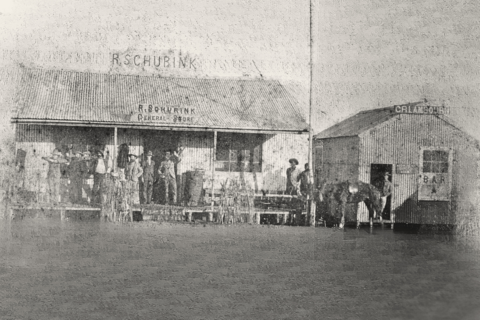
This photograph captures two neighbouring establishments that once formed part of the commercial core of Kaapsche Hoop: R. Schurink’s General Store and C. R. Lambourn’s Bar.
Archival stand diagrams traced by the Lambourn family place these buildings along Kruger Street, likely near the Government School — suggesting this was part of the civic and commercial heart of the settlement.
R. Schurink — General Dealer
Advertisements describe Schurink as a wholesale and retail dealer, licensed to buy gold, paying the best price for produce.
His store supplied mining tools, provisions, general household goods and trade services. In a frontier town, a store like this was both marketplace and informal bank.
The township plan names him. “Schurink” is written across stands 65 and 66, on Kruger Straat near Klip Street — in a block otherwise marked Government.
C. R. Lambourn’s Bar
Next door stood C. R. Lambourn’s Bar, visible in the same historic photograph. Bars in mining settlements functioned as social centres, news exchanges, business negotiation spaces and rest stops for transport riders.
Liquor licensing notices from the Barberton District show that alcohol sales were carefully regulated — reflecting the importance and impact of such establishments in frontier towns.
The end of the trail
Schurink kept a store here and a Lambourn kept a bar beside it. Both men are gone, and so are the buildings.
But of everything this village built — the government offices, the gaol, the post office, the school, four hotels — the trade that has never once stopped on this mountain is the one that sells a traveller a drink at the end of a long road.
You have reached the end of the trail. The village has outlasted almost everything in it.
From Diggings to Settlement
The proximity of a general dealer, a licensed bar and the Government School reveals a settlement transitioning from rough camp to structured township.
Commerce and community were intertwined here.