
Adam’s Calendar (Inzalo Yelanga), Kaapsehoop
Stone · Landscape · Evidence · Story · Living Meaning
Stone, Story and Living Meaning
Stone · Landscape · Evidence · Story · Living Meaning
High on the grassland escarpment near Kaapsehoop lies a striking formation of dolerite stone known internationally as Adam’s Calendar and today also widely known as Inzalo Yelanga — “Birthplace of the Sun.” Variant spellings in contemporary sources include Inzalo ye Langa and Inzalo y’Langa.
Extraordinary claims have been made about this place. It has been described as an ancient calendar, an astronomical observatory, a sacred initiation site and one of the oldest human-made structures on Earth.
But what does the evidence actually tell us?
Discover Kaapsehoop approaches Inzalo Yelanga differently: we separate what can presently be demonstrated from the stories, traditions and beliefs that have gathered around the stones.
You do not have to believe every story to understand why people keep coming here.
Explore the experiences →Before the Stories
The formation lies within the high grassland landscape of the Mpumalanga escarpment. Weathered rock rises through the grass while the land falls dramatically toward the Lowveld.
Before deciding whether the stones are a calendar, monument or sacred site, it is worth simply looking at the landscape. Notice which forms stand upright and which merge into the underlying rock. Notice the horizon, and how the place changes with mist, wind, sunrise and season.
The rocks themselves came before the stories.
What SAHRA Found
The Grade I nomination and the official investigation
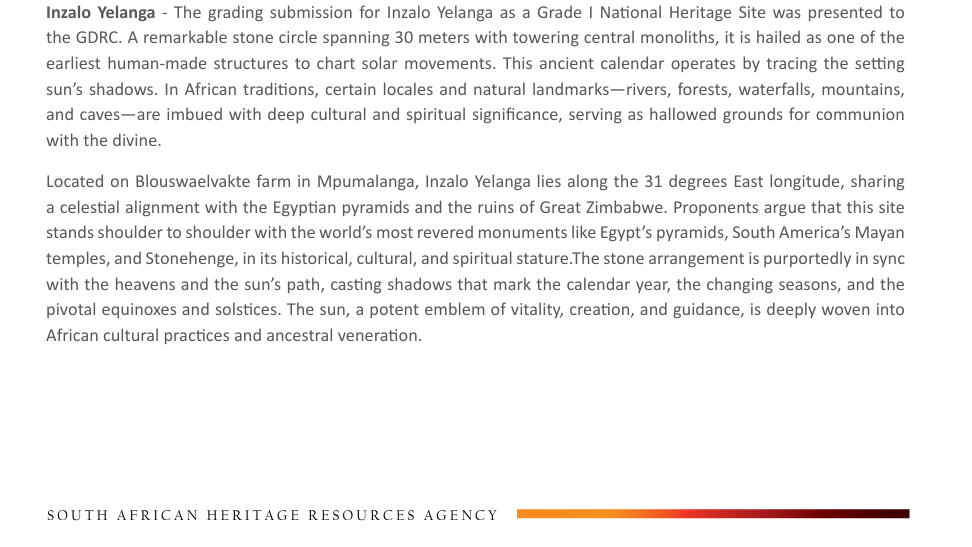
Inzalo Yelanga was submitted to the South African Heritage Resources Agency (SAHRA) for consideration as a Grade I National Heritage Site.
The grading submission described a roughly 30-metre stone circle with prominent central stones and presented the site as an early human-made structure associated with solar movement, shadows, seasons, equinoxes and solstices. It also proposed wider astronomical and cultural connections.
These were claims presented in the nomination. They were not SAHRA’s conclusions.
The investigation
SAHRA subsequently examined the geological setting of Inzalo Yelanga.
Its 2023/24 Annual Report records the presence of the Kaap Valley Pluton and a series of substantial dolerite dykes forming weather-resistant ridges. SAHRA reported that the stones on the escarpment appear to form part of a natural dyke system — a geological phenomenon common in the region.
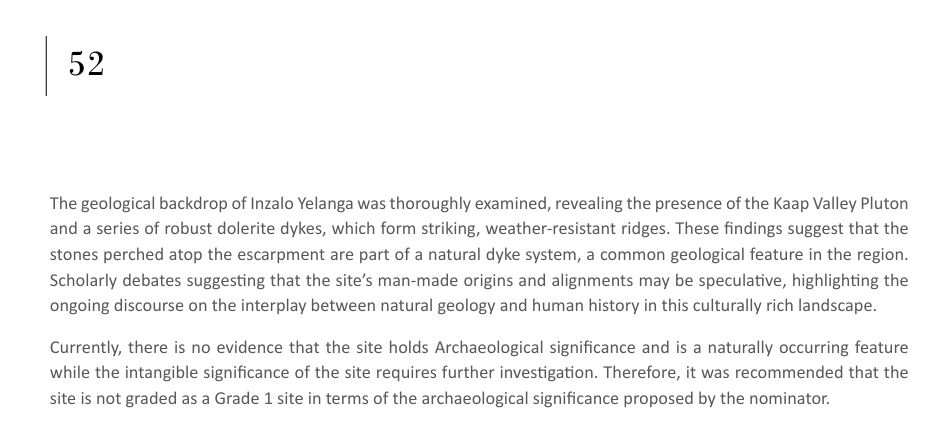
“Currently, there is no evidence that the site holds Archaeological significance and is a naturally occurring feature while the intangible significance of the site requires further investigation.”South African Heritage Resources Agency, Annual Report 2023/24, p. 52
SAHRA recommended that the site not be graded as a Grade I site on the archaeological significance proposed by the nominator.
What Does That Actually Mean?
What the evidence presently supports
The SAHRA investigation supports a natural geological origin for the formation. There is presently no demonstrated archaeological basis for describing Adam’s Calendar as a human-built calendar tens or hundreds of thousands of years old.
What remains open
SAHRA did not conclude that the place has no cultural meaning. Its report specifically states that the site’s intangible significance requires further investigation.
These are therefore two different questions:
What formed the stones?
and
What have the stones come to mean to people?
Read more about the rocks of the escarpment on our Geology of Kaapsehoop page.
Bokoni: An Extraordinary Regional Context
Across a vast area of the Mpumalanga escarpment, between Ohrigstad and Carolina, lie stone-walled homesteads, terraces, roads and livestock enclosures associated with Bokoni. Peter Delius, Tim Maggs and Alex Schoeman describe a complex landscape extending across more than 10,000 square kilometres, and archaeological work has shown sophisticated approaches to farming, cattle management, settlement and movement through the landscape. Recent dating places early Bokoni settlement phases as far back as the fifteenth century. These are genuine African archaeological achievements, deserving to be understood on their own terms.
Stone-walled homesteads
Evidence of settlement and community life
Terraced agricultural slopes
Ingenious land use and farming
Livestock enclosures
Integral to cattle management
Roads & pathways
Stone-lined routes linking communities
Lived, working landscape
Shaped by farming, movement & community
Context is not attribution. Bokoni provides important regional archaeological context. It is not evidence that the particular formation known as Adam’s Calendar was constructed by Bokoni communities.
Explore more of the region’s past: Kaapsehoop: A Layered Human Landscape · the Heritage Archive
Did You Know?
Dolerite forms when molten rock intrudes into fractures in older rock and cools below the surface; a sheet of it cutting across older rock is called a dyke. Over long periods erosion can strip away softer material while the more resistant rock remains — leaving ridges, blocks and upright-looking forms that can appear strikingly placed without having been erected by people.
The Modern Adam’s Calendar Story
The name Adam’s Calendar belongs to the modern interpretive history of the formation. Johan Heine and Michael Tellinger brought the formation to international attention in the early 2000s and subsequently interpreted it as an extremely ancient astronomical calendar.
Their 2008 book, Adam’s Calendar: Discovering the Oldest Man-Made Structure on Earth, helped make the site internationally known.
Extreme antiquity
Proposed ages of about 75,000 years, and far greater antiquity in later alternative-history accounts. Not established by archaeological evidence.
Intentional astronomical construction
The interpretation that the stones were deliberately set out to track the sun and seasons. An alternative-history claim, not established archaeology.
Orion alignments
Proposed relationships between particular stones and the stars of Orion. Not shown to demonstrate intentional ancient design.
Ancient gold-mining civilisations
Links proposed between the site and a lost civilisation associated with ancient gold mining. An alternative-history claim.
Credo Mutwa and Inzalo Yelanga
Vusamazulu Credo Mutwa (1921–2020) was a South African traditional healer, author and storyteller whose work on African stories and beliefs became widely known. His connection with the Kaapsehoop stones requires careful sourcing.
Michael Tellinger reported that during his first meeting with Credo Mutwa in August 2008, the 87-year-old traditional healer recognised the site and told him that he had undergone initiation there in 1937.
Independent biographical sources confirm that 1937 was an important year in Mutwa’s initiation into traditional healing. Mutwa himself later referred to being initiated “for the first time” in 1937.
However, the sources examined by Discover Kaapsehoop have not yet independently established that this documented first initiation took place at the Kaapsehoop formation.
What Mutwa is documented as saying
South African History Online records that in 1937 Mutwa was attacked by mineworkers and fell seriously ill, and that he was afterwards initiated and became a sangoma. In a keynote address published in 2000, Mutwa referred to being initiated “for the first time” in 1937. Neither source, as examined, names Kaapsehoop.
What Tellinger reported Mutwa told him
According to Tellinger, Mutwa recognised the place in August 2008 and said he had been initiated there in 1937. This is significant attributed testimony; it is not independent documentary proof that an initiation took place at this formation.
The responsible position is neither to dismiss the testimony nor to upgrade it into proof: we identify who said what, when, and where the documentary trail presently stops.
Inzalo Yelanga — “Birthplace of the Sun”
Inzalo Yelanga is the principal spelling used on this page because it is the form used by SAHRA. Variant spellings in contemporary sources include Inzalo ye Langa and Inzalo y’Langa.
The name is now used in heritage, cultural and spiritual contexts. However, Discover Kaapsehoop has not yet located an early archival source demonstrating how far back the use of this name for this specific Kaapsehoop formation extends.
Earlier evidence may exist; if it is found, this account will change. A name can carry real meaning for the people who use it today without an undocumented antiquity being claimed for it.
A Living Spiritual Landscape
Contemporary African spiritual and Kemetic groups now gather at Inzalo Yelanga, including around the September seasonal turning and the African New Year.
Some contemporary Kemetic groups honour Credo Mutwa, but this does not establish that Mutwa himself followed the particular Kemetic calendar system now associated with the site.
The site’s modern cultural story is made of different strands. They sometimes meet, but they are not one tradition:
- Credo Mutwa’s teachings — traditional healing, ancestral knowledge and storytelling
- Heine/Tellinger alternative history — the ancient-calendar interpretation
- Contemporary Kemetic practice — including African New Year observances
- New Age and earth-energy beliefs — brought by visitors from many backgrounds
Discover Kaapsehoop does not present contemporary spiritual interpretations as evidence of the site’s ancient origin, nor do we prescribe what visitors should believe.
Visiting with Respect
Ask before photographing people. Respect is compatible with scepticism — no visitor is required to adopt a spiritual explanation.
Sunrise at the Stones
Sunrise and sunset positions change predictably along the horizon through the year. The equinoxes and solstices are real astronomical events: at the equinoxes day and night are roughly equal in length, and at the solstices the sun reaches the extremes of its rising and setting positions.
Heine and Tellinger proposed astronomical relationships between particular stones and these events. The site has not been scientifically shown to be an ancient astronomical calendar: establishing that would require evidence that the stones were deliberately placed, that the sightlines are consistently defined and meaningful, and an archaeological context of human use.
Magnetism, Sound & Sensation
Visitors often hear claims about magnetic behaviour, sound, vibration or energy at Adam’s Calendar. These subjects deserve curiosity — and careful language.
Compass observations
Dolerite may contain iron-bearing minerals capable of affecting magnetic instruments locally. Heine and Tellinger have reported unusual compass deviations around particular stones. Specific angles of deviation have not been independently established by a published, controlled geophysical study, and phone compasses can also be affected by calibration, nearby metal and electronics.
Sound
Please do not strike or tap the stones. Claims that the stones ring because of quartz, that the formation was ancient sound technology, or that it carries energy vortexes, ley lines or healing frequencies are not established scientific findings.
Sensation
People sometimes report calm, emotion or a heightened sense of presence in powerful landscapes. Such experiences can be meaningful to the individual; on their own they are not measurements of an external energy field.
Resonance at Adam’s Calendar is a contemporary sound-and-landscape experience inspired by listening, stillness and place — not a reconstruction of an ancient or indigenous ceremony.
Far-Reaching Grandeur
Why human beings seek sacred landscapes
Across the world, people have attached spiritual meaning to mountains, rivers, caves, springs, forests and unusual rock formations. At Brú na Bóinne in Ireland and at Stonehenge in England, human-made monuments stand within wider landscapes of ritual meaning; at Machu Picchu in Peru, built sanctuary and sacred mountain form a single whole. These places prove nothing about the antiquity or purpose of Inzalo Yelanga. They show something simpler:
A place does not have to have been constructed by human hands to become meaningful to human beings.
Kaapsche Hoop, 1900
During the South African War, the Rev. Edward P. Lowry passed through Kaapsche Hoop with the Guards’ Brigade. He described rocks “so grotesquely shaped and utterly fantastic” and the immense panorama from the escarpment edge:
“It is such a view of far-reaching grandeur as I may never hope to see again, even were I to roam the wide world round.”Rev. Edward P. Lowry, With the Guards’ Brigade from Bloemfontein to Koomati Poort and Back (1902), ch. XII, “Through Helvetia”
Lowry’s account is historical evidence of the landscape’s power to inspire awe more than a century ago — long before the modern Adam’s Calendar story. It is not evidence of ancient sacred use.
More on the village’s past: The Kaapsehoop Story.
Before Adam’s Calendar — A Local Memory
The author’s family connection with the Kaapsehoop mountain extends for more than a century. Within the inherited family memory and records available to Discover Kaapsehoop, no tradition was passed down identifying this particular formation as an ancient calendar, ceremonial sanctuary or place of initiation. It was not singled out in that family history in the way it is today.
This does not tell us what every community may have believed before that family’s time, nor does it exclude traditions outside the family’s knowledge. Absence from one family’s oral history is not proof that ceremony never occurred. It is simply one piece of local historical testimony.
C. Currie-Latré · Discover Kaapsehoop family archive and oral historyFamily testimony and oral history — not an archaeological source.
What We Know — and What We Don’t
What we know
- SAHRA investigated the site.
- Its geological assessment favours a natural dolerite dyke formation.
- SAHRA found no evidence of archaeological significance presently demonstrated for the formation.
- The wider region contains important Bokoni archaeology.
- Heine and Tellinger created the modern Adam’s Calendar interpretation.
- Tellinger reported his 2008 encounter with Credo Mutwa.
- Inzalo Yelanga now has documented contemporary cultural and spiritual significance.
- The Kaapsehoop landscape was inspiring written descriptions of awe long before the modern Adam’s Calendar story.
What remains unproven or unresolved
- That the formation was constructed as an ancient calendar.
- That people erected the principal stones in remote prehistory.
- That it is 75,000, 200,000 or 300,000 years old as a human-built structure.
- That the modern Kemetic calendar interpretation represents the site’s ancient original purpose.
- Exactly when the name Inzalo Yelanga first became associated with this particular formation.
- Whether Credo Mutwa’s reported 1937 experience at this specific site can be independently corroborated.
- Whether reported magnetic effects have been established by controlled scientific measurement.
Good heritage interpretation does not fear unanswered questions. It preserves them.
Visit Inzalo Yelanga
Four ways to experience the formation known as Adam’s Calendar and the escarpment landscape around it — each bringing together the geology, the regional archaeology, the modern story, contemporary meaning and the simple experience of being on the mountain.
Guided Visit
R400 pp
Walk among the stones and explore the evidence, the history, the stories and the competing interpretations, with time on the wider ridge.
Group rates available on request.
Book a guided experienceFirst Light at the Stones
R500 pp
Arrive before sunrise and experience first light among the stones themselves, followed by simple coffee as the landscape wakes.
Advance booking essential. Group rates available on request.
Book a guided experienceResonance at Adam’s Calendar
R650 pp
A CodedHealing® Sound & Landscape Experience. After exploring what is known — and what remains contested — about the site, an introduction to sound and resonance using CodedHealing® tuning forks, guided listening and the natural soundscape of the escarpment, closing in quiet. A contemporary sound-and-landscape experience inspired by listening, stillness and place — not a reconstruction of an ancient or indigenous ceremony.
Advance booking required; selected dates, subject to weather and site access. Group rates available on request.
Book a guided experiencePilgrimage Sunrise Hike
R650 pp
Watch sunrise from the lookout on the opposite ridge before hiking into the site for a deeper guided experience through landscape, history, story and meaning.
Includes pre-departure coffee, individual trail provisions and water, and the Adam’s Calendar Digital Companion Guide. Advance booking essential. Group rates available on request.
Book a guided experienceSite permit: A site permit may apply. Confirm the current permit and access conditions when booking.
Book a guided experience
All four experiences are guided and booked directly with Discover Kaapsehoop. Message us on WhatsApp and we will confirm availability, timing, meeting point and current permit conditions. Advance booking is essential for First Light, Resonance and the Pilgrimage.
Book a Guided ExperiencePrefer to arrange it by email? Contact us. · See all our tours and experiences. · The Adam’s Calendar Digital Companion Guide is available separately for R120 as an optional add-on — and is already included with the Pilgrimage Sunrise Hike.
You do not have to believe every story to be moved by this place.
Inzalo Yelanga stands at an unusual meeting point: ancient geology, an extraordinary African archaeological landscape, modern alternative history, living spiritual practice and the simple human experience of standing on a mountain beneath an immense sky.
Some questions have answers.
Some remain unresolved.
And some belong not to archaeology, but to the person standing quietly on the ridge.
Visiting the stones? Adam’s Calendar — The Complete Visitor’s Guide tells the full story — the geology, the history, the legends and the meanings people bring to it today — fully illustrated, and it works offline at the site.
Buy the Visitor’s Guide — R120Also available in paperback and Kindle editions on Amazon.
Official source (primary): South African Heritage Resources Agency, Annual Report 2023/24, p. 52 — the Inzalo Yelanga grading submission and assessment. SAHRA annual reports.
Regional archaeology: P. Delius, T. Maggs & A. Schoeman, Forgotten World: The Stone-Walled Settlements of the Mpumalanga Escarpment (Wits University Press, 2014); R.-A. Birin, A. Schoeman & M. Evans, Wits University research on the dating of early Bokoni settlement (2021). Cited for the wider landscape only — not as evidence of how the Adam’s Calendar formation came to be.
Historical testimony: Rev. E. P. Lowry, With the Guards’ Brigade from Bloemfontein to Koomati Poort and Back (1902), ch. XII, “Through Helvetia” (Project Gutenberg); Credo Mutwa, keynote address to the Living Lakes Conference (published 2000).
Biography: South African History Online, “Vusamazulu Credo Mutwa”; South African Government, “Sport, Arts and Culture pays homage to late Credo Vusamazulu Mutwa” (1 April 2020).
Contemporary practice: North-West University, “NWU IKS celebrate September as African New Year and the month of new beginnings” (2021); Great Empire of Kemet movement materials — cited only for that movement’s own contemporary teachings.
Comparative landscapes: UNESCO World Heritage Centre (Brú na Bóinne; Historic Sanctuary of Machu Picchu); English Heritage, “Understanding Stonehenge.”
Local memory: C. Currie-Latré, Discover Kaapsehoop family archive and oral history.
The modern Adam’s Calendar narrative (described, not cited as authority): J. Heine & M. Tellinger, Adam’s Calendar: Discovering the Oldest Man-Made Structure on Earth (2008); M. Tellinger’s published account of his August 2008 meeting with Credo Mutwa. Named as the sources of the interpretations described above — never as evidence of the site’s age, origin or geology.