
Kaapsehoop Historical Cemetery
A living archive of the mountain’s people, families and landscape
The cemetery holds the whole society of a gold-rush village. Its oldest graves (1883–84) are a row of single, foreign-born diggers; its 1901 graves include three Anglo-Boer War British soldiers and a concentration-camp survivor; a later cluster died of the miners’ lung diseases of the De Kaap and New Amianthus mines. Prospectors and a mine manager, a hotel-keeper and a wagon-maker, a lawyer and the household-keeping women, infants and the very old — all in one ground.
An honest note: 173 is the documented number, including 12 unknown interments; unmarked graves mean the true total is higher, and the record grows as more headstones and death notices are read.
Kaapsehoop’s oldest graves are its loneliest: single, foreign-born diggers who died within two years of the 1882 rush and were buried by the veld-cornet under the old Weeskamer law. Among them lie J. D. O’Neill of Ireland (d. 1 March 1883), William Pleace of Plymouth — a watchmaker among the diggers (d. February 1883) — and William Young of Scotland, a digger of 56 (d. January 1884), with Dutch and Danish diggers beside them. No families, small estates: the human first chapter of the gold rush.
A living archive of Kaapsehoop’s people, families and landscape — preserved through generations of care and ongoing restoration.
The Kaapsehoop Historical Cemetery is one of the most significant heritage sites on the mountain, preserving burial records, family histories, and the legacy of those who shaped the village. Established in the late nineteenth century, it serves as a place of remembrance and a living historical archive of Kaapsehoop.
This cemetery is not only a resting place for early prospectors, families, and soldiers, but also a continuous record of the community’s history — reflecting periods of frontier life, wartime, and modern preservation through generations of care.
Burial Records & Cemetery Map
The Kaapsehoop Historical Cemetery archive includes searchable burial records and mapped grave locations, accessible through the digital cemetery system.
Cemetery Enquiries & Interment Procedures
All burials and interment arrangements at the Kaapsehoop Historical Cemetery are handled by the Kaapsehoop Conservancy.
📩 Interment Enquiries:
kaapschehoopvillage@gmail.com
Grave Information & Records
All enquiries relating to grave locations, burial records, inscriptions, family information, or any cemetery-related records—regardless of date of interment—must be directed to:
📞 Claudette Currie
+27 60 852 8682
📩KaapsehoopRIP@gmail.com
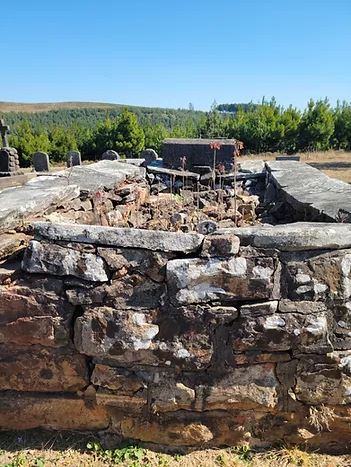
Kaapsehoop Historical Cemetery
Heritage & Cultural Context
The cemetery forms part of Kaapsehoop’s broader cultural landscape, linked to early settlement patterns, historic access routes, and long-standing family stewardship. Its location, layout, and burials reflect the realities of frontier life, conflict, illness, and endurance on the escarpment.
The site is recognised as a place of memory, dignity, and continuity, rather than a closed or static monument.
A Lineage of Care
The Kaapsehoop Historical Cemetery has never been abandoned. Its care has been carried forward through generations, ensuring continuity of stewardship for over a century.
Late 1800s – 1960s
The cemetery was cared for by Daisy and May Lambourn, daughters of Charles Rupert Lambourn, one of Kaapsehoop’s founding families. Daisy maintained the cemetery until her death in 1963, and May until 1967.
1960s – 1992
Custodianship passed to Ivy Thompson, Daisy’s daughter, who faithfully looked after the cemetery until she left Kaapsehoop in 1992. Ivy passed away in 1994.
1992 – 2007
Care was entrusted to Richard (Dick) and Laurette Latré, who maintained the site until their departure from Kaapsehoop in 2007.
2007 – recent years
Following the Latrés’ departure, care became informal but continuous. Members of the Kaapsehoop village community took turns mowing the grounds, repairing fencing as needed, and keeping a watchful eye over the cemetery. Their efforts ensured that the site remained respected and protected during a period without formal custodianship.
Periods of long grass did not indicate neglect, but reflected the realities of a small mountain community maintaining a historic site with limited resources.
Today
Custodial care has returned to structured stewardship rooted in historical lineage, supported by community cooperation and a renewed focus on documentation, conservation, and long-term preservation.
Seasonal Growth & Living Landscape
During the summer months, parts of the cemetery are intentionally left unmown to allow seasonal wildflowers to emerge across the grounds.
Among these are clusters of Coreopsis lanceolata — a non-indigenous flowering plant now naturalised within the cemetery landscape. These flowers appear most densely around long-established family plots, particularly within the Lambourn section.
Their presence suggests earlier periods of planting, likely part of informal grave tending practices carried out by those who maintained and cared for the cemetery across generations.
Today, these flowers form part of the site’s living character — a quiet continuity between past and present, where traces of human care remain visible in the landscape itself.
To safeguard the cemetery’s history for future generations, burials and records are now being preserved through the Chronicle Digital Cemetery.
This digital archive provides:
Online access to burial records and historic death notices
Photographic documentation of graves and monuments
Protection of original research through watermarking and copyright safeguards
Recent death notices not yet available through public genealogy platforms are securely held offline to ensure respectful stewardship and prevent unauthorised reuse.
Visitors and researchers are welcome to explore the digital cemetery or to contact the custodians for deeper archival access or to contribute verified information.
Visiting with Respect
Visitors are welcome to experience the cemetery quietly and respectfully.
Those wishing to support restoration work, participate in heritage events, or contribute historical information are encouraged to get in touch.
In recent years, community members have contributed time and effort to maintaining the cemetery through mowing, fence repairs, and regular monitoring.
Building on this foundation, current restoration efforts include:
Digital archiving of burials and historical records
Grave restoration, including the repair of historic wooden crosses
Cleaning and preservation of headstones and monuments using conservation-appropriate methods
To ensure the long-term protection, ethical management, and historical integrity of the Kaapsehoop Historical Cemetery. Ongoing preservation is supported through community effort, research, and independent archival work to support its ongoing preservation and archival stewardship.
This framework supports:
Responsible custodianship grounded in historical lineage and continuity
Ethical archival management and controlled access to sensitive records
Conservation-based restoration and long-term planning
The Kaapsehoop Historical Cemetery remains a place of remembrance and respect — a testament to the families, soldiers, and individuals whose lives shaped the mountain village, and to those who continue to safeguard its legacy.
Source: Kaapsehoop Historical Cemetery records, burial register and the cemetery restoration project.
The record: the Kaapsehoop Historical Cemetery interment database (searchable by surname); 84 surname folders of death notices, wills, marriages and headstones; the surviving Lambourn burial log; the cemetery plot map and headstone survey.
Wider research & care: FamilySearch and Transvaal civil death & marriage registers; Anglo-Boer War casualty and medal rolls; the UCT concentration-camps database; the cemetery restoration project and the Kaapsehoop Conservancy. Living-descendant genealogy is not published here.