
Restoration Projects
Documenting, conserving and caring for the graves — one at a time
Grave by grave, the Kaapsehoop cemetery is being documented, cleaned and stabilised — conservation-first work that protects what survives without erasing its age.
Purpose and Approach
The Kaapsehoop Historical Cemetery is an active heritage landscape rather than a static memorial space. Restoration work focuses on documentation, conservation, stabilisation, and respectful maintenance, guided by historical accuracy and long-term preservation rather than cosmetic renewal.
All work recognises the cemetery as a layered landscape reflecting mining, war, settlement, migration, and family history. Preservation balances access, care, and authenticity.
Land Status and Historical Context
Surface rights to state land for cemetery use were issued to the proclaimed township of Kaapsche Hoop in 1913, formalising burial use that began in 1882.
The land remained state-owned and was never transferred as a deeded municipal cemetery. Surrounding land later became forestry holdings and is now subject to restitution processes.
In the absence of continuous municipal management, care has relied on local custodianship and community-based stewardship.
Digital Documentation and Record-Keeping
A comprehensive digital register forms the foundation of restoration work. Graves are recorded using:
• Inscriptions
• Family records
• Archival sources
• On-site verification
The digital system supports:
• Accurate identification
• Archival cross-referencing
• Conservation planning
• Public interpretation
Entries clearly distinguish between verified information and records requiring further confirmation.
Physical Conservation and Grave Care
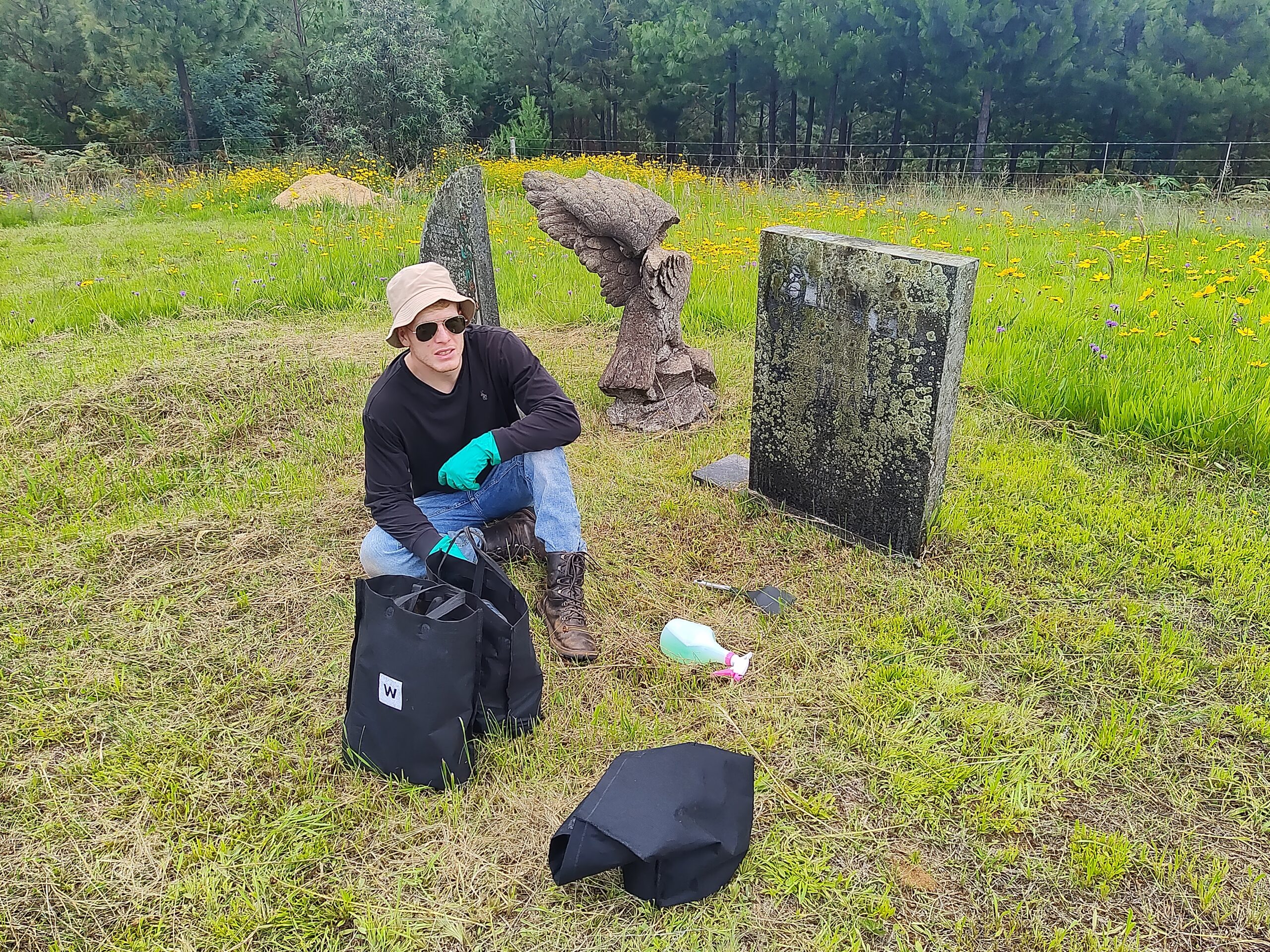
Hands-on conservation work has included the careful cleaning of approximately fifteen historic graves to date, using non-invasive methods appropriate to aged stone and metal. This work prioritises the preservation of original material, inscriptions, and patina, avoiding abrasive or damaging techniques.
Grave care is undertaken incrementally, with attention given to stability, legibility, and respect for the original form of each memorial.
As part of this work, the original sleeper-wood cross marking the grave of William Cooke has been carefully restored. The cross, which had deteriorated over time due to exposure and age, has been stabilised and conserved and is scheduled to be respectfully returned to the grave site.
Physical Conservation and Grave Care
Approximately fifteen historic graves have been carefully cleaned using non-invasive methods appropriate to aged stone and metal.
Work prioritises:
• Preservation of original material
• Retention of patina
• Protection of inscriptions
• Structural stability
The original sleeper-wood cross marking the grave of William Cooke has been stabilised and conserved and is scheduled for respectful reinstatement.
Cemetery restoration project
Metalwork Conservation
Historic metal surrounds are repaired and stabilised to prevent deterioration from corrosion, soil movement, and weather exposure.
Original configurations are photographically documented to guide future reinstatement where necessary.
Cemetery Infrastructure and Grounds Maintenance
General maintenance — including grass cutting, tree care, and fence upkeep — is undertaken through village structures.
The perimeter fence, installed by SAFCOL in the early 2000s following a formal request by Richard (Dick) Latré, continues to protect the site.
These activities are distinct from conservation and archival work.
Grave Numbering and Ground-Marker System
A heritage numbering system has been introduced to align physical graves with the digital archive.
• Original grave numbers are retained
• New heritage numbers reflect verified archival sequencing
• The digital archive remains the authoritative record
Stainless steel heritage markers are being installed in phases.
Memorialisation of Lost and Unmarked Graves
Where burial records survive but grave locations are lost, individuals are documented digitally and will be commemorated through a dedicated memorial element.
This approach avoids speculative marking and aligns with international heritage practice.
Challenges and Constraints
As with many community-led heritage initiatives, restoration work proceeds within practical and structural constraints.
Progress is shaped by:
• Funding availability
• Volunteer capacity
• Access to specialist conservation expertise
• Environmental conditions
• Land status and governance complexities
Some projects advance steadily; others pause until appropriate resources or skills become available. This phased approach reflects a deliberate commitment to responsible conservation rather than rapid intervention.
Preservation work is undertaken incrementally to ensure long-term stability and historical integrity.
Ongoing and Future Work
Restoration and conservation at the Kaapsehoop Historical Cemetery is an evolving, long-term process.
Planned and continuing work includes:
• Further grave cleaning and structural stabilisation
• Completion of the heritage numbering system
• Continued conservation of historic metalwork
• Ongoing archival verification and digital record enhancement
• Installation of memorial elements for lost or unmarked graves
• Development of interpretive material linking burials to Kaapsehoop’s wider history
Work progresses in phases as resources, research, and technical capacity allow.
Stewardship and Continuity
The restoration initiatives documented here are grounded in custodianship rather than ownership.
Each intervention — whether digital documentation or physical conservation — contributes to safeguarding the cemetery as:
• A place of memory
• A historical record
• A cultural landscape
The objective is continuity: ensuring that Kaapsehoop’s layered history remains visible, traceable, and respected across generations.
Source: Kaapsehoop Historical Cemetery restoration project records.