
From Gold Rush to Mining Industry
How the creek diggings of the Kantoor became reef mines, machinery and companies — and how, within twenty years, the mining faded and the village endured.
For twenty years, gold was the whole reason Kaapsche Hoop existed.
Where The Birth of Kaapsehoop ended with the founding of the village, this page follows the gold itself — from alluvial washing in the creeks to reef mining, machinery and companies, and the long decline that followed. One honest caution runs through it: no reliable record of how much gold the Kaapsche Hoop workings actually produced survives, so this is a history of the industry and its people, not a ledger of ounces.
From the creeks to the reefs
The first gold on the Kantoor was the easy kind. It lay alluvial — loose in the gravels of the creeks — and a man with a pan, a shovel and patience could win it without capital or company. Word of it drew the first diggers up onto the plateau, and for a season or two the creeks were the whole of the industry.
But the alluvial gold was shallow and soon worked out. The gold that would last was locked in reef — hard quartz that had to be blasted, hauled and crushed before it gave anything up. Reef gold could not be won with a pan; it needed stamp batteries, water, tramways, money and men who answered to shareholders. The whole story of mining at Kaapsche Hoop is the story of that shift: from the independent digger at the creek to the company at the reef.
The Berlin farm and the Barrett brothers
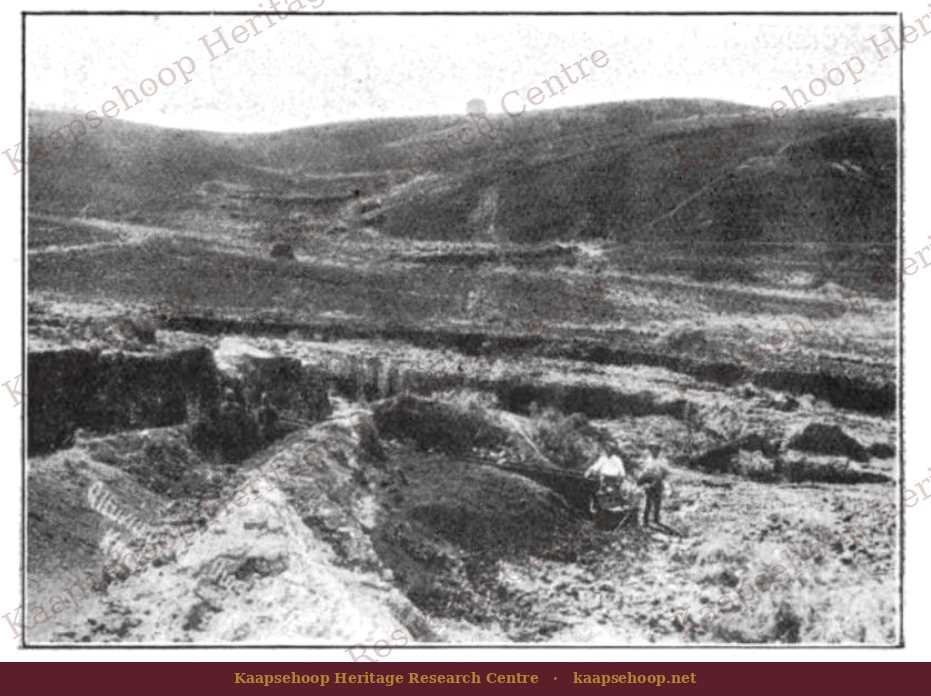
Not all the gold went to the diggers. The plateau's mineral ground lay largely on the farm Berlin, next to the village, and Berlin passed into the hands of the Barrett brothers, Middelburg merchants, as a Government concession. Meiring dates that grant to June 1882; the earliest record of it in the Transvaal archive, however, is not a grant but a protest — Acting Gold Commissioner Ziervogel's objection to the Berlin farm survey, lodged on 9 September 1882. Over the next two years the farm's boundary was contested — at one point the Government office and camp themselves were said to fall inside it — and in January 1884 the courts found for the Barretts.
The concession had a human cost, and the archive records it plainly. In January 1884 Johanna van Brede petitioned on behalf of the "women and children driven from Berlin by the Barrett brothers." It was one chapter in a larger shift — from ground a man could dig to ground a company owned — and it is set down here as a chapter, not as the whole story.
The goldfield fractured — the law arrived too late.
Machinery arrives, 1884
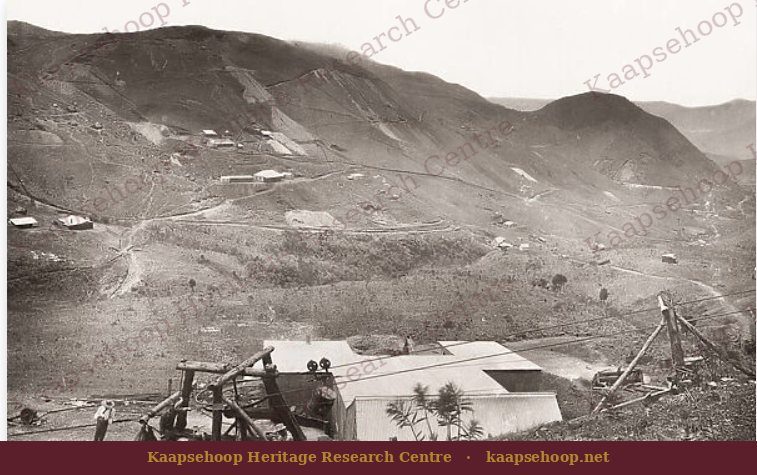
The reef gold could not be reached without machinery, and in 1884 the machinery came — by ox-wagon. Tom Andrews, a Pietermaritzburg wagon-builder, bought a stamp battery at the Umgeni Iron Works and hauled twelve ox-wagons of equipment to the De Kaap in a journey of some six weeks. The engineer Percy Whitehead erected it at Barrett's Berlyn property near Kaapsche Hoop — described in the sources as the first significant mining machinery in South Africa. It was a small thunder of stamps in a place that a year or two before had known only the pan and the shovel, and it marked the moment the diggings began to become an industry.
Companies, capital and the reefs
With machinery came companies, and with companies came London money. The Barrett Gold Mining Company was registered in London on 22 January 1885, reconstructed in 1887 and again in 1892 as the reefs were chased deeper. Names that recur in the records — Acutt, Eustace, the Rautenbach reef — belong to this second phase, when the field was no longer a scatter of independent claims but a set of concessions, plants and prospectuses. By 1897 the cyanide process was being tried on the dolomite to squeeze gold from ore the stamps alone could not free. The creek-digger's world was gone; the mining engineer's had replaced it.
The human story
Behind the concessions and the company registers were people. The rush brought diggers and their families up onto a cold, high plateau on the strength of a rumour and a hope; it brought storekeepers, butchers and saloon-keepers to serve them; it brought investors who never saw the place and put their money on it anyway. For a few years there was optimism enough to haul a stamp battery across the Lowveld by ox-wagon and to float a company on the London market. And then, as the reefs thinned, there was the other side of it: the disappointment, the wound-up companies, the families who moved on to the next field and the ones who stayed. The gold rush was a human event before it was an industrial one, and most of its people left no more trace than a name in a docket.
The long decline
The turn came quickly. Gold Commissioner Wilson resigned in 1886 amid the friction of the Berlin dispute, and a commission under Smit was appointed to inquire into the office; de Stoppelaar took the post over. The costliest symbol of the field's ambition — a railway said to have cost £80,000 — lay, in Reunert's words of 1893, with its "bridges and masonry fallen into chaotic ruin" within a decade of being built. The richer reefs of Barberton and, soon, the Witwatersrand drew the men and the money away. By the time Eustace died in 1901, the mining that had made the mountain was all but over.
The wider field — and where Kaapsche Hoop fits
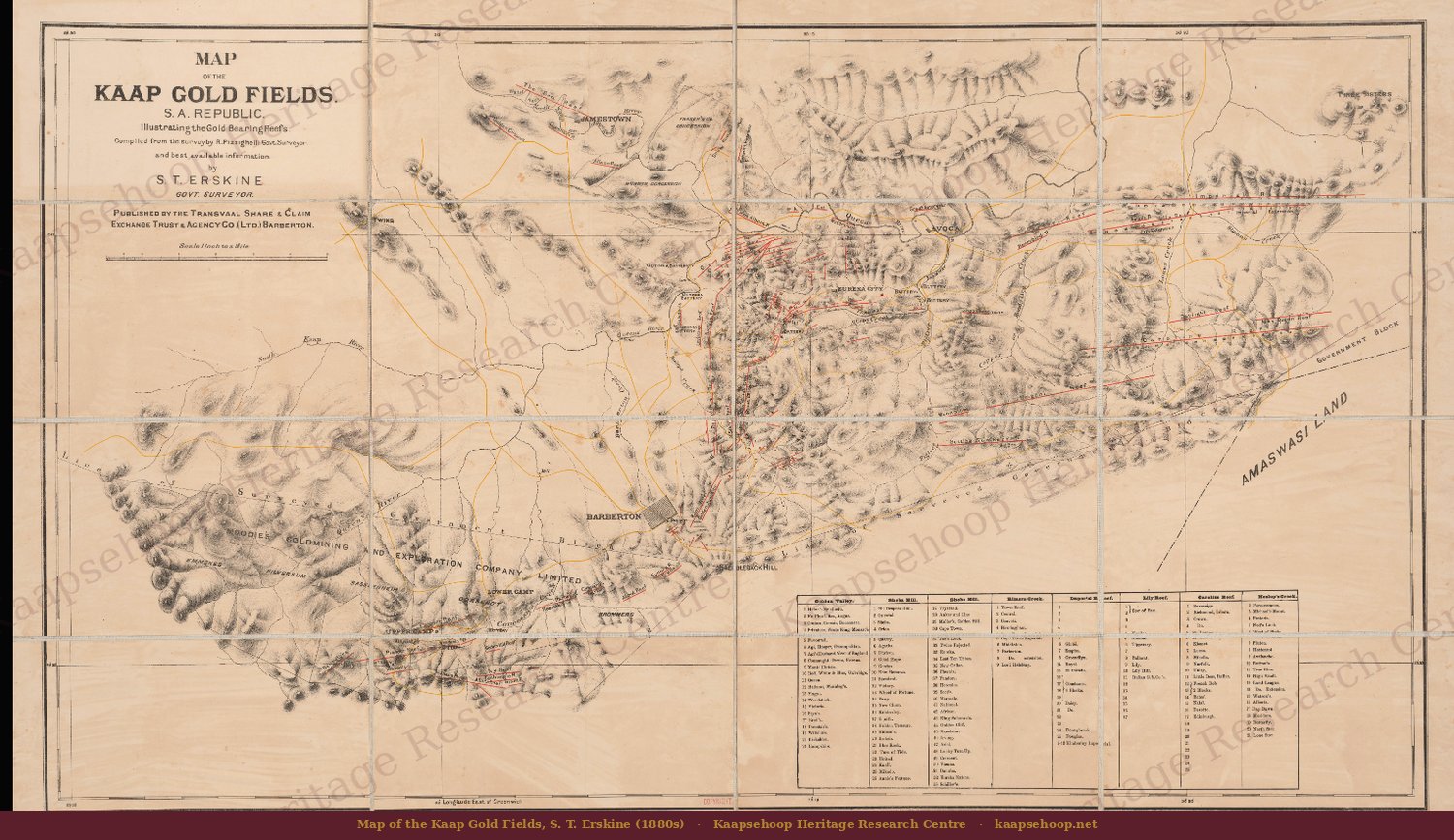
Kaapsche Hoop's mining was never the whole of the De Kaap. The famous reefs of the rush — Sheba, the Pioneer — lay to the south, at Barberton, and it was there that the great fortunes and the great scandals of the field were made. Kaapsche Hoop was the northern edge of the same goldfield: the Kantoor and Berlin ground, worked under the same South African Republic mining law and concession regime, but smaller, higher and colder than the Barberton valley. Barberton belongs here only as context — the centre against which this northern corner should be read, never confused with it.
bridges and masonry fallen into chaotic ruin— Theodore Reunert, Diamonds and Gold in South Africa, 1893, on the De Kaap railway
- When was the Berlin concession granted? Meiring gives June 1882. The Transvaal archive does not confirm that date — its earliest Berlin document is Ziervogel's protest against the farm survey of 9 September 1882, and the dispute it opened was not decided in the Barretts' favour until January 1884. On this page the June-1882 date is attributed to Meiring, not stated as archival fact.
- How much gold did Kaapsche Hoop produce? No reliable production figures survive for the Kaapsche Hoop workings specifically. Rather than repeat an estimate the record cannot support, this page says plainly that the output is not known.
What remains today
The mining left more on the ground than in the ledgers. Old workings and adits still scar the reefs; spoil heaps and the stone foundations of plant and offices lie under the grass; the faint lines of tramways and water-races can still be traced by those who know where to look. Some of the buildings the industry raised survive in the village, and its vocabulary survives in the place-names — the Kantoor above all. What the gold left behind was not a mine but a landscape that still remembers one.
Gold transformed the mountain for a brief moment. For twenty years the creeks and reefs of the Kantoor drew diggers, machinery and London money; then the richer fields elsewhere, the ruined railway and the exhausted reefs drew them away again. What the gold left behind was not a fortune but a village — the offices, the cottages and the people who stayed after the gold was gone.
Continue through the story
← Back to The Birth of Kaapsehoop · On to The Geology of the Plateau, Buildings & Landmarks and the Historical Cemetery.
Every date and name on this page rests on the archival and published record. The Kaapsehoop Heritage Research Centre holds the dockets, maps, company notices and photographs behind it.
Primary archival: Transvaal Government Archives (SS series) — the Berlin dispute dockets, incl. Ziervogel's protest (1882) and Johanna van Brede's petition, R589/84 (1884); Deeds Office registers.
Contemporary published: W. H. Penning, The Geology of the Kaap Gold Fields (1883); Theodore Reunert, Diamonds and Gold in South Africa (1893); the South African Mining Journal; official year-books and mining handbooks of the period.
Later historical works: F. E. T. Curror, Eureka City (1964); D. J. Meiring, Dynamite and Daisies (c.1975); Clara Soal, History of Kaapse Hoop (1975).